
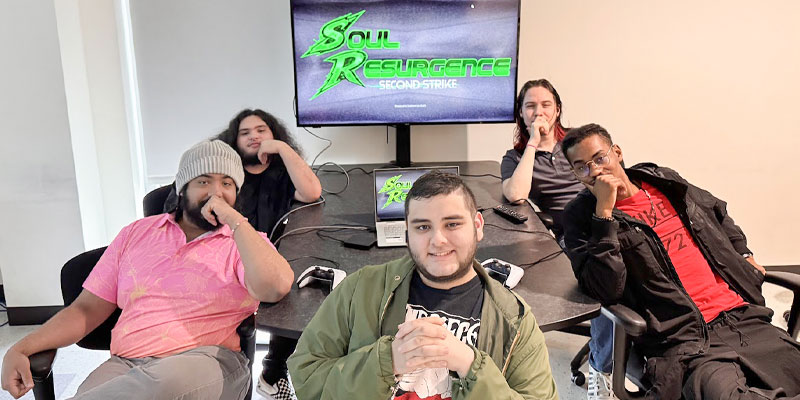
Students in San Jacinto College’s simulation and game design program took their classroom skills to the digital fighting arena with Soul Resurgence: Second Strike, the program’s first student-created fighting game.
For David “DJ” Thomas, full-time lead professor of game and web development, watching students go from talking about games to building one is the best part of the job.

Game logo
The game features six characters battling to reclaim their lost souls, with 3D models and stages presented on a 2D plane. It started with classroom discussions about games like Mortal Kombat, Soulcalibur, and Killer Instinct as inspirations.
Building the game
“If you’ve got an idea, no matter how far-fetched it is, trust me, we’re going to give you the necessary tools and support you need to make your dreams come true,” Thomas said.
In the Game 2359 group project course, students turned their idea into reality. Compared to other types of games, designing a fighting game required more development.
The students accepted the challenge with only 10 weeks to create three game levels.
Joining forces
Determination was not limited to class time.
“Students often meet outside regular class and lab hours to work through game elements like scripts, art, timing, and hit boxes,” Thomas said. “Alumni stay in close contact and maintain relationships with current students. This adds another layer of collaboration.”
To balance the workload, students took on roles equal to their strengths and interests.
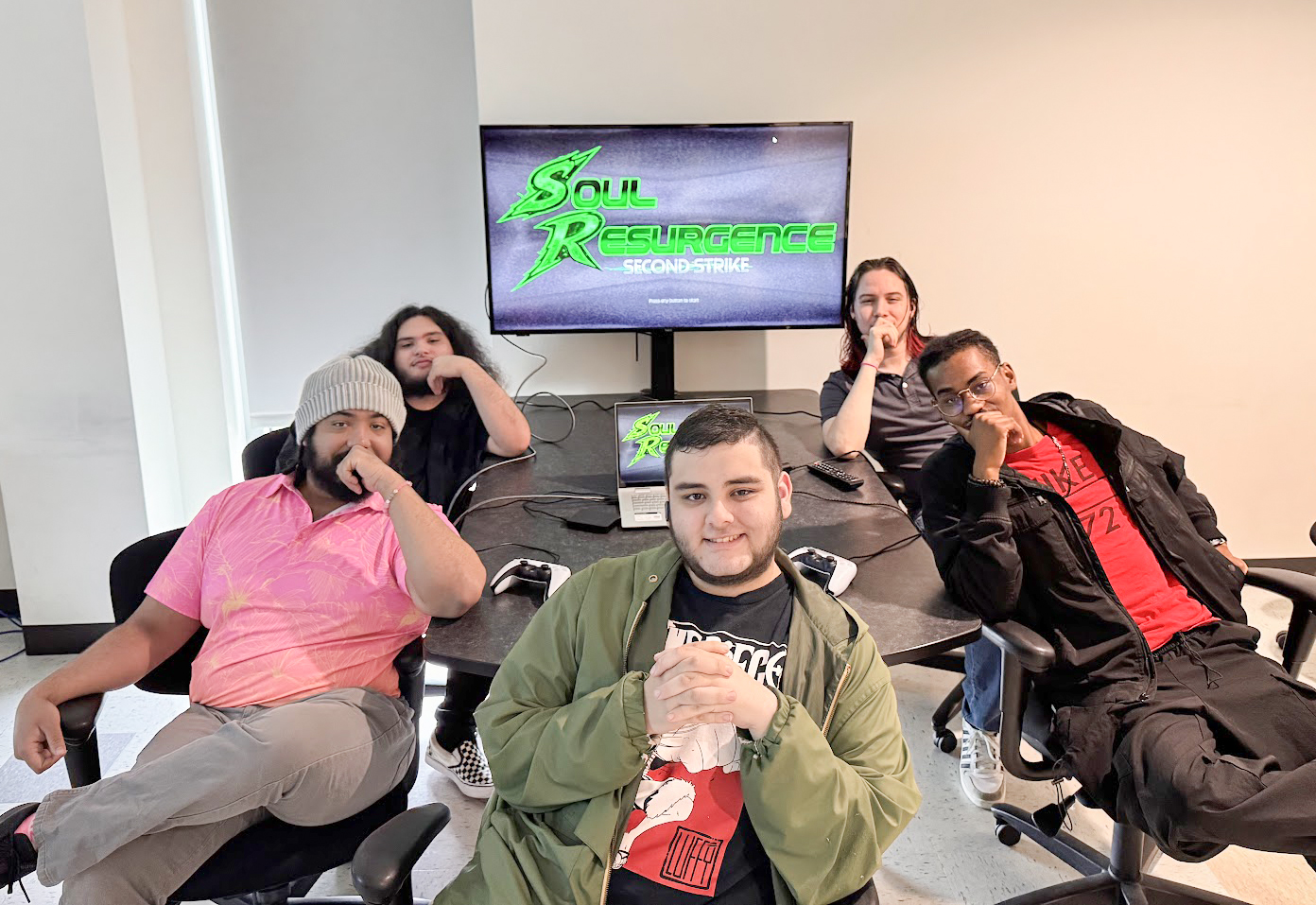
Game design team
Keanu-Nikolas Figueroa-Karabanoff was the project lead. Kaleb Daniels worked as audio engineer and lead story writer, bringing experience as a producer. Eric Vela served as game design lead, programmer, and animator, with Nathan Moore as lead animator. Nikolas Rodriguez’s roles were level designer and story writer. Heather Ware, San Jac alumna, volunteered her time to work as the character modeler.
“The game is about a tournament hosted by Death herself, where dead fighters compete for a second chance at life,” Figueroa-Karabanoff said. “When it came to building the scenes, we wanted each stage to fit the darker feeling of the game while still giving the fighters an interesting place to battle and show their character’s personality.”
The team worked on elements like environment, lighting, effects, and backgrounds to help make each scene feel like it belonged in the game’s world.
“All the characters are in the afterlife, which is a different plane of reality,” Vela said. “We made characters from different eras, a character from the Roman gladiator era, one from present day, with different backgrounds and motivations. We made everything from scratch, no assets were used, and none of us had any 3D experience.”
More than gameplay
Studying game design means much more than simply loving to play games.
Soul Resurgence: Second Strike is still in the alpha stage and moving toward beta.
Thomas hopes to feature the game as a competitive title at the College’s fighting game community tournament. He encourages students to dream big, perhaps working on it with the likes of Ubisoft or Bethesda someday.
Leveling up
Moore’s main role was animation, which he found challenging but enjoyed every moment.
“Being an artist and animator was my dream ever since I started classes here at San Jac. Now it becomes a reality, but, boy, is it difficult,” Moore said. “I learned that time management is more important than you think. We all start somewhere, and that’s OK. Perfection is but a mere illusion, and that is what boosted my confidence to keep going forward.”
As a competitive gamer and Superman fan, Vela dreams of making superhero games.
“I would love to make superhero media eventually in all mediums, comics, games, anime, and movies,” he said. “All we can do is work as hard as we can, hoping for the best.”
“I’m just a regular guy who loves games, but here I am helping make a game that San Jac hasn’t really seen before, and seeing people enjoy it and talk about it is just amazing.” — Keanu-Nikolas Figueroa-Karabanoff, project lead
Figueroa-Karabanoff is finishing his last semester. Like Ware, he plans to stay connected with his “awesome” teammates to work on the game.
Daniels felt that the course prepared him to fulfill his role on the team, while allowing him to stick to his areas of expertise.
“It was fun to write story and dialogue, design characters, and compose and mix the music tracks. Working on this project was the highlight of this degree for me,” he said.
Learn more about the game design program.
By Neesha Hosein